
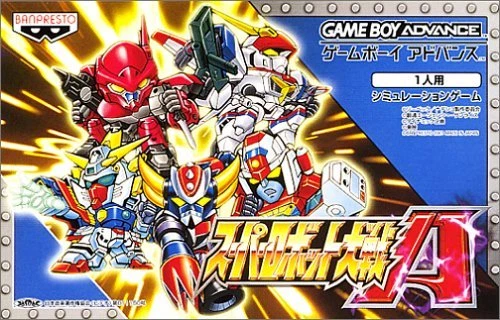
Covers the Game Boy Advance version of Super Robot Wars A as a product. Platform and release date follow the official Super Robot Wars website, participating series and systems follow Banpresto's official game website at the time of release (archived copy), and unit names, forms, and placement follow material researched by the site operator. The PSP version *Super Robot Wars A PORTABLE* is not covered, and this page is not a guide verified through play for the actual appearance or permanent joining conditions of every unit.
Sources checked 2026-10-16Units and map icons by participating series
The roster groups participating series by franchise, such as Mazinger, Getter, and Gundam. Transformed and combined forms are bundled into the base unit's card and shown as "Forms +N." If you cannot find the unit you want, check the neighboring group in the same series. Click a unit name or image to go to this site's unit article, or a pilot name to go to the pilot article (where an article exists).
The full roster table of series and units is on the Korean page →
To find your favorite series in Super Robot Wars A, start with the list of featured series that Banpresto announced before release. The roster below is not an acquisition table of allied units only. It groups enemies, ships, and transformed and combined forms by series, so you can check each unit's look and name together.
Battles and participating series in A
Super Robot Wars A is a simulation RPG that Banpresto released for the Game Boy Advance. At the time of release, Banpresto's official game website introduced it as Super Robot Wars, born on the Game Boy, "greatly evolved and arriving on the Game Boy Advance." Official introduction
The list of featured series on the same page has 21 series plus Banpresto originals.
- First appearances in the series: Martian Successor Nadesico and Metal Armor Dragonar (機甲戦記ドラグナー). The page said the エステバリス of the Nadesico can swap equipment to match its style of combat, such as ground, air, 0G, and heavy frames, and that the Dragonars split into roles: D-1 for close combat, D-2 for long range, and D-3 for support.
- Gundam: Mobile Suit Gundam, Mobile Suit Zeta Gundam, Mobile Suit Gundam ZZ, Mobile Suit Gundam: Char's Counterattack, Mobile Suit Gundam 0083: Stardust Memory, Mobile Suit Gundam: The 08th MS Team, Mobile Fighter G Gundam, and Mobile Suit Gundam Wing Endless Waltz. The page noted that G Gundam was appearing for the first time in a long while since Super Robot Wars 64.
- Muteki series: Super Machine Zambot 3 and The Unchallengeable Daitarn 3.
- Mazinger and Getter: Mazinger Z, Great Mazinger, UFO Robot Grendizer, Getter Robo, Getter Robo G, and Shin Getter Robo (Original Manga Version). The page said Getter 1, 2, and 3 gained a special ability, "Open Get," which splits them apart to fully dodge an enemy attack.
- Director Nagahama's series: Super Electromagnetic Robot Combattler V, Super Electromagnetic Machine Voltes V, and Tōshō Daimos. The page noted that the three series appear together for the first time in the series.
- Banpresto originals: The page said fully Original protagonists and robots appear, and that you choose one of two protagonists, male or female.
The roster's groups do not match the official list 1:1. Each unit is grouped by the original series this site has linked it to, so a series counted as one entry in the official list may appear as a group with a different name, and two series such as Getter Robo and Getter Robo G may appear as one group. For that reason, the series count at the top of the roster does not equal 21.
Systems
The system overview on the official website highlighted the following elements. System overview
- Support actions: A system brought in from Super Robot Wars COMPACT2. There are two kinds: "Support Attack," which triggers when attacking on the allied phase, and "Support Defend," which triggers when countering or defending on the enemy phase. The supporting unit and the supported unit must be adjacent, support uses must remain, and both must be at the same altitude (air or ground). Support Attack does not trigger with combination attacks.
- Shield defense: Units that carry a shield perform shield defense automatically, regardless of the pilot's Skills. Damage comes out of the shield's durability (SH gauge). When durability hits 0, the overflow damage goes to the unit itself, and the unit can no longer use shield defense after that. Durability can be raised through weapon upgrades, and a broken shield is replaced by boarding a battleship or with "Resupply."
- Counter: A Skill that lets a unit strike first with a set probability when attacked on the enemy phase. This attack is always a critical, and it does not trigger when a support action is involved. The page said melee-type pilots such as the Shuffle Alliance (G Gundam) and Kazuya Ryuzaki (Daimos) learn it.
- Combination attacks: The page announced that the combination attack system from Super Robot Wars 64 was included.
Platforms and versions
- Game Boy Advance version (original): Released on September 21, 2001, according to the official Super Robot Wars website. Names and images in the roster below are based on this version. Official lineup
- PSP version: The same lineup lists Super Robot Wars A PORTABLE as a separate product released for the PSP on June 19, 2008. The roster in this article is based on the Game Boy Advance version, so units from the PSP version are not included.
Sources
- Official Super Robot Wars website — Lineup (platforms and release dates of A and A PORTABLE)Checked 2026-10-16
- Banpresto official game website SUPER HOT WEB — Super Robot Wars A story and featured series (2001 archived copy)Checked 2026-10-16
- Banpresto official game website SUPER HOT WEB — Super Robot Wars A system overview (2001 archived copy)Checked 2026-10-16
Found an error or something to correct?
Request a correction